

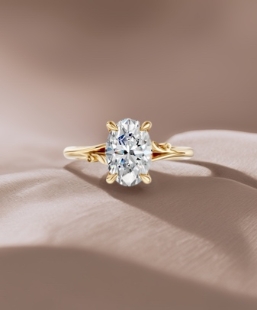
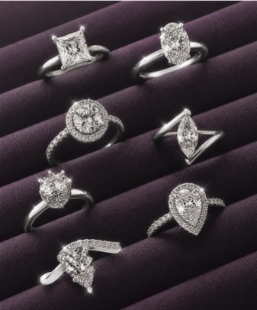
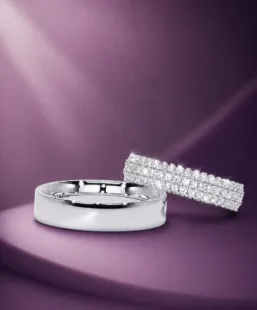
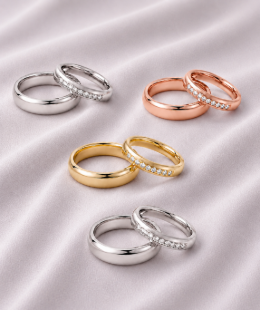
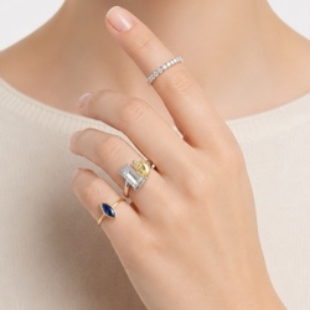



Let's take a look together at an engagement ring created in a Romanian workshop. We have chosen a "show-stopper" through its design and its delicate setting. Placed on the finger of a bride-to-be, it certainly doesn't go unnoticed. The halo of brilliants embracing the central diamond makes this engagement ring a collector's piece. Its value isn't just gold and precious stones. There are feelings involved, and everyone should be aware of that: from the designer and the jeweller, right through to the person who actually buys the jewellery. The buyer doesn't have to be an expert, and the fact that they aren't knowledgeable — and aren't obliged to be — should by no means turn them into a victim. That is precisely why, when someone sets out in search of a diamond engagement ring or a pair of gold wedding rings with diamonds, the specialists' advice has been and always will be this: gather as much information as you can, from every source possible and impossible. You should see buying a piece of gold and diamond jewellery as an investment of the heart, but also a financial one, because if you choose internationally certified natural diamonds and gold based on the right alloys (which contain no nickel or cadmium or other toxic compounds and are chosen to give the jewellery maximum durability), the sums can range... from reasonable upwards. In other words, there is a financial cost that the act of buying a piece of jewellery entails. But the mistakes a potential buyer can make are linked not so much to choosing an unreliable or untrustworthy supplier as, far more often, to the jewellery itself. Depending on the colour of gold the customer chooses, the jeweller can offer clarifying advice regarding the price/quality ratio and, therefore, a smart purchase. "Carried away", the customer tends to choose "the very best of everything" from the outset. This is where the mistake comes in: a diamond of colour D or E (the whitest grades) with VVS1/VVS2 clarity (top clarities) is set in a ring whose mount doesn't show the diamond off to advantage (see photo, example 1). What's more, the diamond will borrow from the colour of the gold, and that D or E colour diamond will look more yellowish, probably an I or a J. See how a good intention can end less happily. Lucian Constantinescu (diamante.ro) states: "We are transparent with our customers and give advice in their interest. Often we suggest cheaper and more spectacular options, but the customer insists that the jewellery be expensive and, perhaps, not very spectacular in relation to the investment made. That is strictly the person's own choice and, as long as we are at peace knowing we have given the best advice, everything is perfect". Speaking strictly about the example given in this article, Lucian Constantinescu adds: "The top diamond illustrated above, I recommend, should be set in a mount like the one in example 2, but in white gold. While the ring in example 1 highlights the diamond, the model in example 2 can hide small imperfections; in this case we suggest setting a diamond with SI1–SI2 clarity. That way you can choose a larger carat (a larger size) while sacrificing the clarity imperceptibly." These are small pieces of advice with great value. All a customer has to do is be open and accept them with confidence. When you come across a brand with thousands of customers and 24 years of experience in the trade, it's simpler. The final decision remains, in any case, the customer's. Source Ziare.com: http://www.ziare.com/life-style/bijuterii/greseli-comune-in-achizitia-unei-bijuterii-cu-diamante-1466789
Common Mistakes When Buying Diamond Jewellery
25 May


