










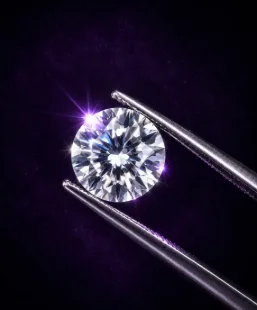
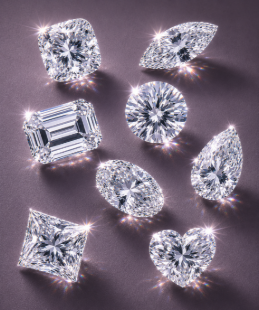
Thanks to technological progress, the luxury segment of jewellery with precious stones has lately seen the arrival of synthetic diamonds.
Without being familiar with this field, you may find yourself in the unpleasant situation of being unable, at first glance, to tell the difference between a natural diamond and a synthetic one, which can be frustrating since you don't know what you're buying. Not even the well-established electronic tester, so common in specialist shops, can distinguish a synthetic diamond produced by the CVD method from a natural one.
What is a synthetic diamond?
To avoid any confusion, it is worth introducing the concept of CVD. This is in fact an acronym for chemical vapour deposition. From this we can gather that the synthetic diamond is made using CVD techniques.
How does the whole process unfold?
Well, on the face of it things seem complex, but on closer inspection the following can be observed. A material (carbon, in this case) is deposited from a gas (a mixture of hydrogen and methane) onto a substrate, with chemical reactions thus coming into play. This method emerged in the '70s and '80s and involves creating in the laboratory conditions of pressure and temperature similar to those in the Earth's crust at the moment a natural diamond forms. In practice, the process that takes millions of years in nature to create a natural diamond is replaced by a laboratory procedure that lasts a few weeks.
In tackling this complex subject, for a full understanding both of the techniques used to make a synthetic diamond and of the actual components involved, it becomes necessary to explain another concept, namely the nanocrystalline diamond. It appears that through forced re-nucleation during the growth of the diamonds, the diamond grains can be kept very small. This material is therefore called nanocrystalline or ultra-nanocrystalline diamond (UNCD). One point worth emphasising is that the material does not display the transparency or thermal conductivity considered to be unique properties of diamond. These characteristics can only be determined in specialised gemological laboratories, using high-performance equipment.
Making a comparison in this way between the synthetic diamond and the natural one, we have reached the following conclusions.
First of all, the synthetic diamond market is not a billion-pound one, as the natural diamond market is. The reason is a simple one: most CVD diamond products are intended for technical applications that serve small market niches (and only rather rarely for jewellery).
Secondly, natural diamonds, compared with synthetic ones, display a wide range of properties which makes them so valuable in the composition of jewellery. In other words, colour, clarity, the presence of tiny imperfections and more all form part of an international classification system, guaranteeing the authenticity and value of the natural diamond formed in the Earth's crust over millions of years, embodying the miracle of this precious stone's formation out of pure energy.
How can you be sure that the diamond you are looking at is a natural one?
Well, a few sure and indisputable proofs would be that the piece of jewellery has a certificate of conformity and a hallmark, and that it is bought from authorised dealers. Furthermore, diamonds with a carat weight greater than 0.10ct. (3mm) are laser-inscribed with a unique safety code and come accompanied by GEMOLOGICAL CERTIFICATES issued by accredited international Laboratories (IGI, HRD, GIA).


